
The Wyoming County Owner-of-Record Card
The CURRENT OWNER label on the Wyoming County parcel card carries the present roll entry. Nearby fields identify the parcel. They also show where that name came from. Treat the card as an assessment record first. Then follow its deed reference to the recorded instrument itself. A tax name says nothing about who occupies the property.
| CURRENT OWNER | Name the assessment roll associates with the parcel |
|---|---|
| Mailing Address | Destination for tax notices, separate from the land |
| Street Address | Situs location, which may be incomplete on a rural tract |
| Deed Book/Page | Clerk reference that can confirm the grantee |
| Legal Description | Lot, tract or deed-based parcel identity |
| Sales History | Assessment-card transfer clue, to be checked against the deed |
The owner of record may live elsewhere, hold the parcel through an entity, or route tax notices to an agent. The street and mailing addresses do different jobs. Treat the mailing line only as a contact clue tied to the property. Confirm the name in the deed's vesting clause.
Fields Beside the Wyoming County Owner Name
On the Assessor card, CURRENT OWNER sits beside MAILING ADDRESS, situs, legal description, deed book and page, Sales History, Assessment Record, and Map/Parcel. Land and property factors round out the card. Topography, utilities, road, traffic, land use, frontage, location and fences fill the factor fields. Those fields show what the assessment record stores. They do not prove a transfer reached the current roll.
The Wyoming County Assessor parcel-card layout shows where the owner, mailing and situs fields sit. Deed-reference fields sit there too. Check the returned result. Not every field is filled for every account.
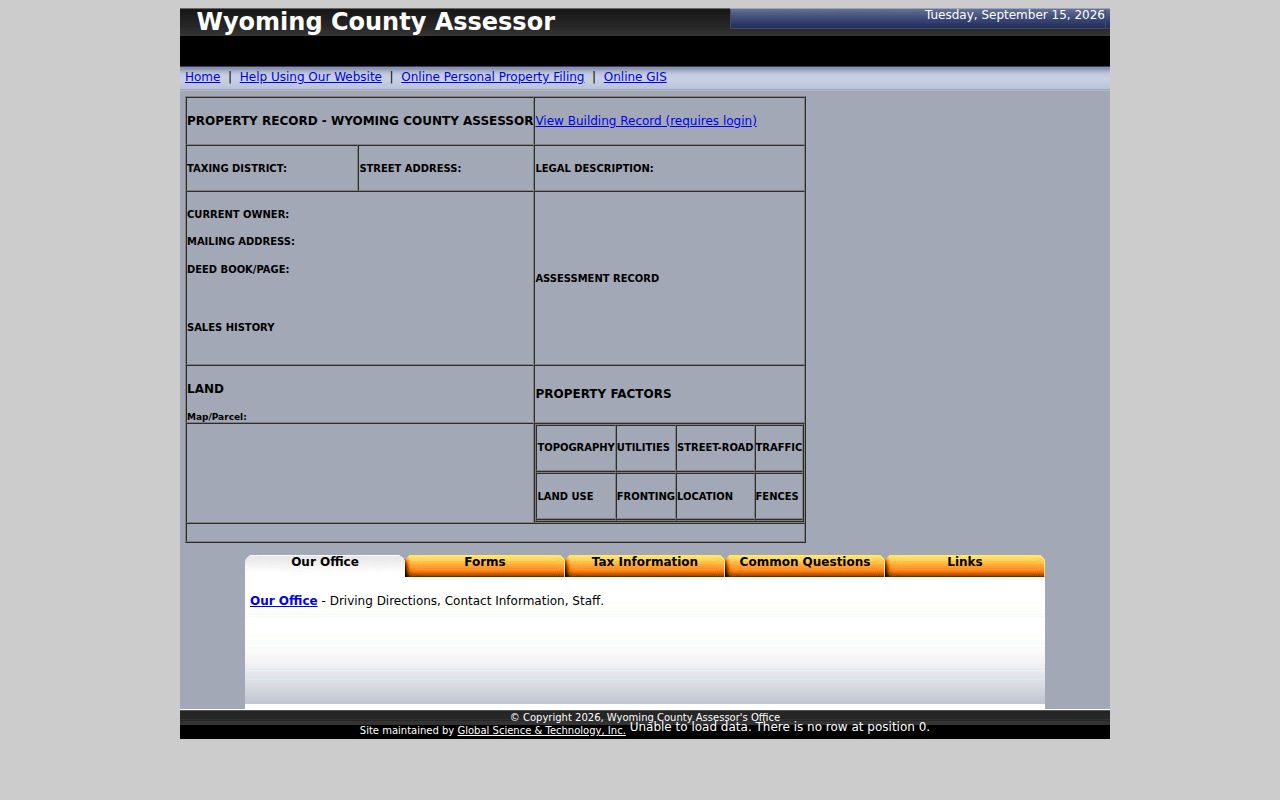
The card links the roll's owner to the deed book.
Wyoming County Situs and Mailing Address
Situs is where the parcel lies. The mailing address is where the Assessor sends tax notices. In Wyoming County, that line may be a P.O. box, company, bank, trustee, or agent address. A tract can also lack a street number. Do not use the mailing line to find the boundary, or assume the record owner gets mail at the house.
County search help notes that a street-only lookup can beat typing an assumed number. That helps when a rural address was assigned after the deed description, or an older tax card lacks an E-911 number. Keep the legal description handy. It anchors both address fields.
Confirming the Current Owner in Wyoming County
To verify the current owner, start with the Assessor entry. Compare it with the latest deed recorded by the County Clerk. The county publishes no live deed-index link or refresh calendar. A search by book and page may have to happen at the record room. So may a search by party name. Entities need extra care. If the record names a company, trust, or estate, trace that grantee exactly as written. Do not swap in a person from another filing.
- Search the county Assessor by owner, address, account or Map/Parcel and open the card.
- Copy the CURRENT OWNER, deed book/page and full legal description.
- Ask the Wyoming County Clerk whether a newer deed, release or corrective instrument has been recorded.
- For an entity, check the state business file; for an estate transfer, check the clerk's probate record.
- Owner of record
- The party named by the county's current assessment card.
- Vesting
- The deed language showing how a grantee takes title.
- Registered agent
- The state-file contact for an entity, not necessarily a resident or owner individually.
Copy the deed's recording date and book/page. For a Wyoming County transfer, match them against the card's owner and sales-history fields. A recent transfer can hit the Clerk's books first. The roll catches up later. No office publishes a day count for that lag, so let the deed date tell you which record is newer.
How Current Is the Wyoming County Roll?
Wyoming County's portal does not publish a roll-refresh calendar or a current online image cutoff for deeds. A new closing, inheritance or corrective filing can therefore appear first in the Clerk's books. Use the assessor year to describe the tax record, not the effective date of every ownership change.
The assessor's annual July 1 date and three-year property visit cycle relate to valuation, with annual changes when the office determines one is needed. A tax-roll owner field therefore should be read with the card's tax year and the latest deed date. Those dates answer different questions and should not be merged into a single claim that the roll is real-time.
The research did not find an official number of days between recording and a roll update. A deed can therefore be newer than the assessor card, especially after a recent sale, estate distribution or correction. The date on a card is an assessment or sales-history detail; it is not a promise that the current record has synced with the clerk's books.
When two sources disagree, compare recording dates and document references. Ask the Assessor whether the roll has been updated and ask the Clerk for the latest recorded transfer. Do not choose a name based only on a map result, because the state viewer may display one owner while a deed lists more.
The Assessor generally assesses property at 60 percent of fair market value as of July 1 and visits real property every three years, with annual adjustments when a change is found. Those valuation cycles do not establish the date of a deed transfer. Treat CURRENT OWNER as the roll's owner entry for the card's year and use the Clerk's most recent instrument to confirm a later conveyance.
Wyoming County Deed Reference Check
The assessor card's deed book and page numbers are a bridge to the recorded instrument itself. Hand those values to the County Clerk along with the parcel's legal description and the names shown. The clerk's office records deeds, trust deeds, releases and plats. State law sets recording and copy fees, so confirm the current charge before you order anything. Ask whether your purpose requires a certified copy.
Grantor and grantee carry precise meanings. A grantor conveys an interest; a grantee receives it. Read the vesting clause and property description closely. Look for any later deed or court order before treating a roll name as settled ownership, because the card alone does not capture every post-recording change.
The record room sits on the courthouse ground floor near Bank and Main streets in Pineville. The mailing line is P.O. Box 309, Pineville, WV 24874, and the office lists (304) 732-8000 with weekday hours of 8 a.m. to 4 p.m. The county offers no searchable online deed index, so call ahead and ask how a book, page or party-name search can be reviewed.
Wyoming County Map Owner Limits
The statewide viewer warns about this itself. A result may show one owner when several hold title. Treat a map pop-up as a way to orient the parcel. It is not the ownership record. The Assessor card supplies the local owner field. The latest deed holds the full grantee and vesting language you actually need.
The assessor sometimes lists an entity. The West Virginia Secretary of State search may surface its filing status, registered agent and mailing address. Those details describe the state filing only. They do not reveal every person who benefits from the entity's property.
A company name on the tax card, for instance, can be matched to a state organization record. A registered agent is just a filing contact. A trust or estate demands close attention. Check the exact grantee and fiduciary named in the deed or probate record. Keep the entity's legal name exactly as written when asking the Clerk to pull an instrument.
Contacting a Wyoming County Property Owner
The tax mailing address is the one the Assessor uses for notices. Those notices serve a legitimate parcel question. The address may belong to a trustee, a company or a representative rather than an occupant. The roll never establishes who lives in the home. Protected addresses stay private. Confidential court or vital data stays private too, even when a parcel owner appears on a tax card.
If a property matter truly requires contact, use the mailing destination for that matter alone. Follow the custodian's rules for an official request. An owner-of-record entry is not permission to enter private land or to reach out repeatedly. When the question concerns the filed deed or a tax-card field, ask the Clerk or Assessor for a record clarification.
Lawful use. Keep any contact focused on the property matter. Do not use a public owner name or mailing address to follow, threaten or harass anyone.