
Finding a Wyoming County Property Owner
Ownership in Wyoming County gets answered in two stages. The assessment roll names the owner of record first. The recorded deed then confirms it.
Work the chain in order. Run the county's public property search by address, pull the assessor card, and note the listed owner. Copy down the parcel number, district, legal description, and the deed book and page citation. Take that citation to the County Clerk and ask for the filed instrument. Watch for later transfers or corrections attached to it. When the record names an LLC, a trust, or an estate, treat the entity as its own search. Its filings or probate record may reveal the people behind the name.
- Search the Assessor by parcel address or street; a street-only search may work best for an older rural situs.
- Read CURRENT OWNER and MAILING ADDRESS, then copy the legal description and deed book/page.
- Confirm the name and vesting in the latest recorded deed held by the Wyoming County Clerk.
- If a company owns it, use West Virginia's business search for the entity and agent; if an estate is involved, check probate.
Wyoming County's CURRENT OWNER Field
The county's parcel-card template carries the exact label CURRENT OWNER. That name sits alongside the situs address. A separate MAILING ADDRESS appears there too. The card also shows the deed book and page, sales history, the assessment record, and land and property factors. So the card works well as a first answer in an owner search. It is still a tax record at heart. No county source says how soon the roll refreshes after a new filing. See the Wyoming County Assessor parcel-card layout for the CURRENT OWNER field. Its separate MAILING ADDRESS field appears on the same card.
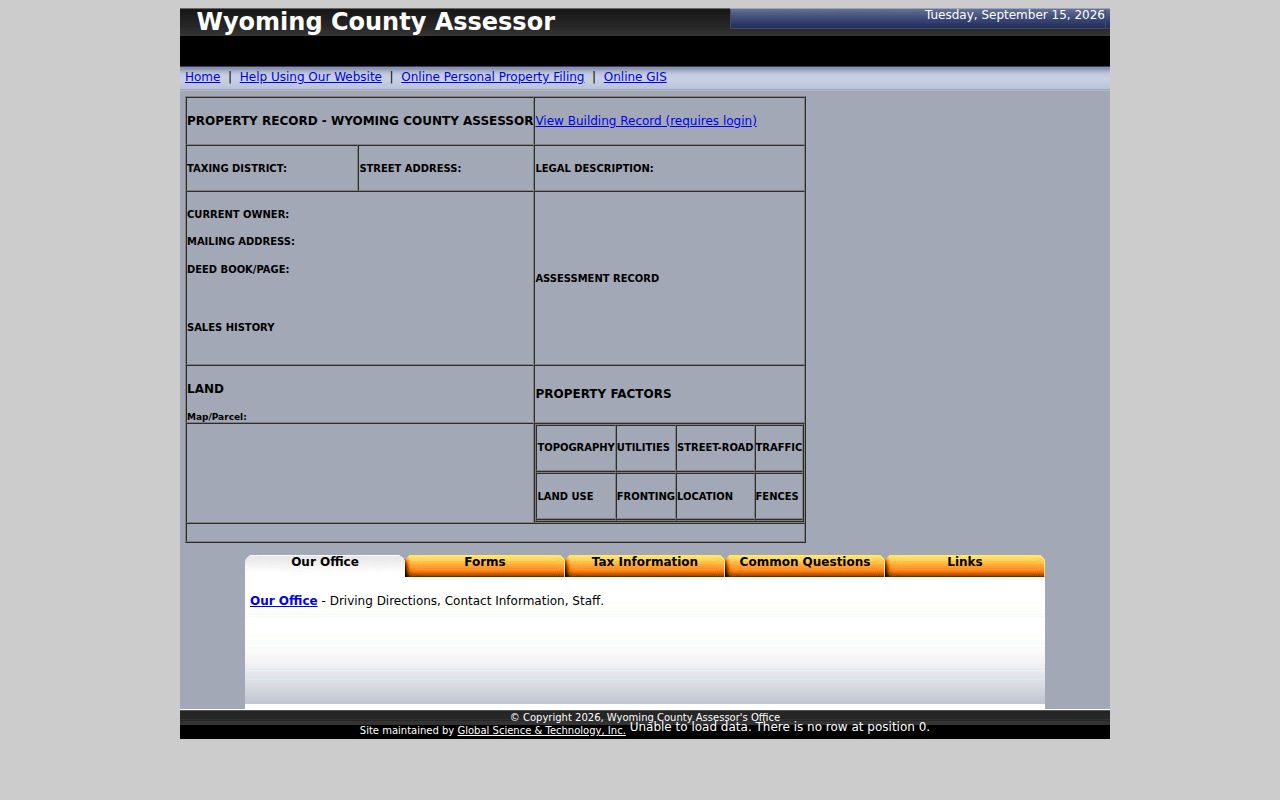
Keep those two labels straight. One names the taxpayer of record; the other says where the tax bill travels.
On a county result, the owner name is a tax-roll field. The deed book and page serve as a locator for the Clerk's filed instrument. Assessment year, class, and total belong to the tax record itself. A map viewer sometimes displays a single owner, or the card names only an entity. That gap is your cue to read the deed. Don't trust one screen to tell the whole ownership story.
Wyoming County Owner Mailing Address Clues
A mailing address tells you where a tax notice goes. It does not always tell you where the land sits. The field may belong to a bank. It may belong to a lawyer, a business, a trustee, an executor, or a P.O. box. Rural parcels can even lack a street number in the Assessor's Parcel Address field. Compare the mailing address against the situs, the legal description, and the district before drawing any conclusion. No single field builds a complete owner profile.
For a lawful property matter, use the official tax-mailing destination. Or ask the records custodian for the proper contact route. The public card proves neither occupancy nor reachability at the situs address.
Where Wyoming County Ownership Appears
A Wyoming County property owner can surface in several records. Only the deed, though, describes the grantee's recorded interest. The Assessor's free search returns a parcel card. The County Clerk holds the recorded deed and probate files. The State Secretary of State portal answers company-record questions. The statewide map helps locate a parcel. Each source has a different keeper and a different purpose. Write down the source and date of every owner clue before comparing them.
The county's assessor help suggests a practical search format. Enter owner names last name first, with no comma. Blank fields are ignored. Street-only searching helps when the address number is uncertain. That form is a way to identify the parcel card, nothing more. Check any name result against the situs, district, and full legal description. Then follow the deed reference to the Clerk.
Each record answers a different piece of the ownership question. The assessor roll gives the present tax-card name. A filed deed names the grantee in a conveyance. A state business record can identify an entity's registered agent. A map can display a parcel and sometimes a single owner value. Cross-check these sources rather than blending them into one conclusion.
| Source | Owner Info It Gives | Access |
|---|---|---|
| Assessor card | CURRENT OWNER, mailing address, parcel and deed reference | Free county search |
| County Clerk land record | Grantee and vesting language on the filed deed | Record room; current online index not located |
| WV business search | Entity status, registered agent and filing address | Free state portal |
| GIS viewer | Parcel location and a map-based owner/ID result | Public viewer; map is not a title record |
The record owner and the occupant of a home can differ. An owner may rent the place out or leave it vacant. An entity may hold title outright. The assessor portal itself warns that more than one owner may exist even when a state result shows one name. Follow the deed's full vesting text rather than inferring co-ownership from a map label.
Wyoming County Owner Name Search Terms
A name alone proves little. Before trusting any match in a Wyoming County property search, weigh the owner name against the district, situs and legal description on the card. The help page explains that blank fields are ignored. Everything you enter gets combined. Start with the exact owner spelling, then drop the street number if one person holds several parcels. Right name, wrong legal description means a different property. Check the map district and account before chasing the deed reference.
The assessor form wants last-name-first order. Skip the comma. Deeds, tax cards and estate files sometimes use an initial or an older family spelling, so test likely variants. Search trusts, LLCs and estates by exact legal name. Shorten the name only if that fails. Owner searches often return several properties with no situs street number.
Adding a second criterion can narrow the list. Avoid guessing a street number when the help page supports street-only searching. The legal description and district separate similar names far better than a mailing ZIP. Keep notes as you go. For a surname that recurs across Wyoming County property records, record each result's district, Map/Parcel number and land wording separately. The same surname rarely means the same owner. It may not even mean the same family or tract. Enter entity names exactly as filed, and test each punctuation or suffix variation as a fresh search.
Fresh Wyoming County Deed Versus Tax Roll
No official county source publishes a fixed roll-refresh interval. A recent sale can leave the deed at the Clerk's office running ahead. It may run ahead of the CURRENT OWNER field on the assessment card. Line up the newest deed date, recording reference and grantee against the card. Should the card cite an older book and page, ask the Clerk a question. Ask whether a later conveyance or corrective instrument exists.
The county offers no online deed-index portal or image range. A gap online proves nothing about what was recorded. So bring the parties, date range and legal description to the record room directly.
The Clerk places the land-record office at the Pineville courthouse, ground floor near Bank and Main streets, P.O. Box 309, Pineville, WV 24874, phone (304) 732-8000. Published weekday hours run 8 a.m. to 4 p.m. Confirm before traveling. Ask which book series or grantor-grantee index covers the transfer date.
Entity and Estate Owners in Wyoming County
An LLC can take title as grantee. A person may show up only as an agent in the state business file. A trust may name a trustee, and probate can show an executor, administrator or devisee. The assessor card and the deed each hold one piece of the trail. Look up the organization or agent through the West Virginia business portal. Then weigh the address and status against the land instrument.
A will drawn up at death can identify property or beneficiaries. Yet it is rarely the recorded instrument that moves title. Search the County Clerk's probate record and land indexes. There, hunt for the executor deed, order of sale or a later conveyance. A death certificate belongs to vital records, not deeds.
When an entity is the owner of record, match its registered name and agent details to the grantee wording. Do not swap in the agent's personal name. An estate entry sends you to the probate file for authority to sell. The deed itself proves the land transfer. County records cover both paths. Neither search excuses you from checking the exact legal description and instrument date.
Limits of Wyoming County Owner Search
A public owner lookup has real limits. It cannot show who lives at a property, who holds keys, whether a transfer is free of every claim, or whether a lot line is correct. The statewide viewer can display one owner while several exist. Protected court records, confidential vital details and address-confidentiality cases carry separate limits under West Virginia law. Treat a name as a record entry only. Confirm title through the latest instrument, and bring any legal decision to the right professional.
Lawful use. Use the information for property research, boundaries and civic due diligence. Do not use it to track, threaten or harass a person, and do not infer where anyone lives from an owner record.